

* SCROLL DOWN FOR MORE PrEP INFO *
What is PrEP?
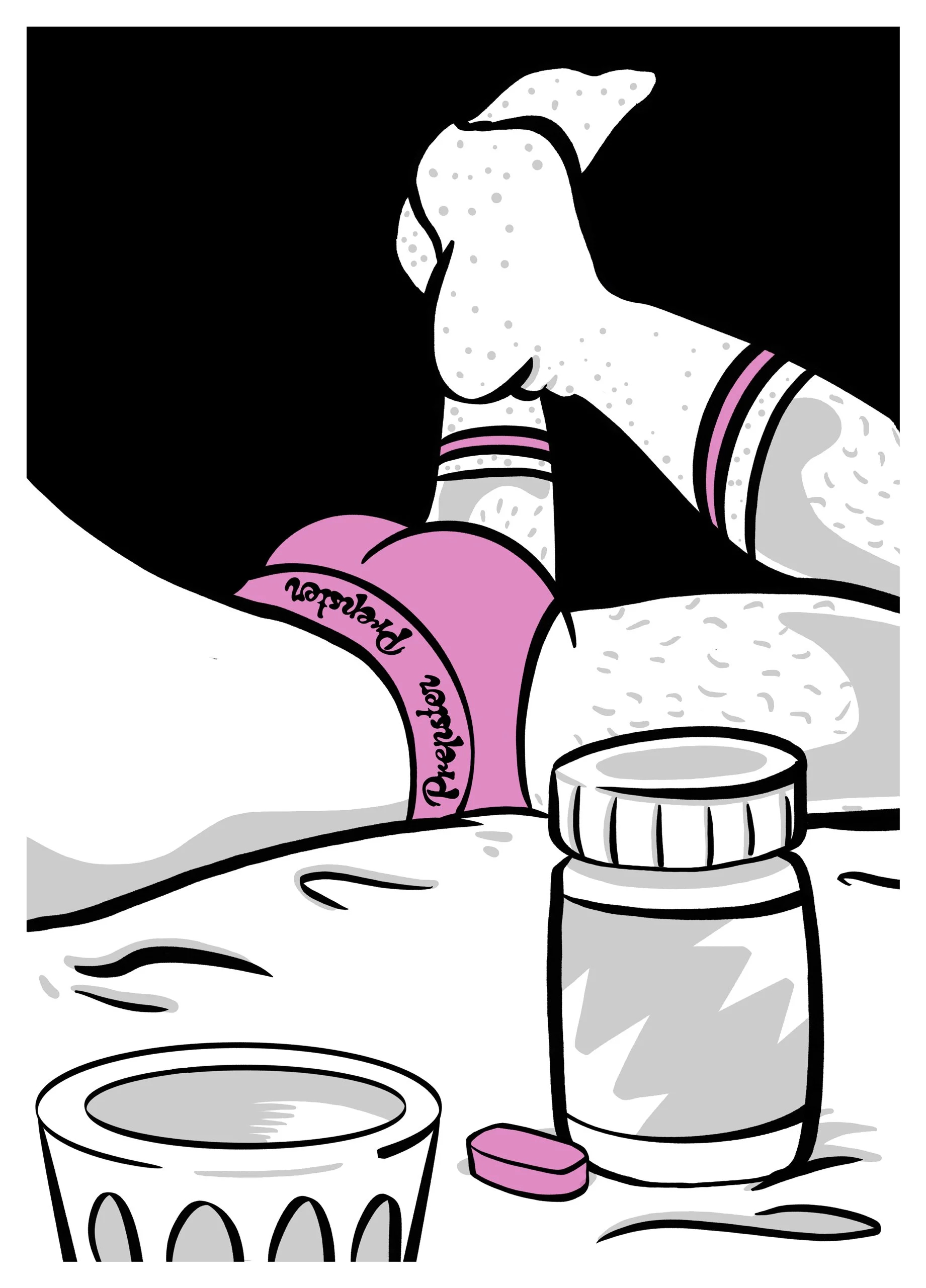
PrEP stands for pre-exposure HIV prophylaxis. It’s a way of preventing HIV by taking medicines before sex.
PrEP is taken by someone who doesn’t have HIV, to prevent them from getting HIV.
PrEP is most commonly taken as a once-a-day-pill.
This is usually taken as a combination of two drugs in one pill – tenofovir disoproxil fumarate (TDF) and emtricitabine (FTC) (sometimes referred to by its original patented name of Truvada or as TDF/FTC). A second pill version of PrEP, using a slightly different formulation of drug - tenofovir alafenamide (TAF) and emtricitabine (FTC) - can also be used as PrEP. This is often referred to by its patented name of Descovy or as TAF/FTC. In the UK, a TDF/FTC version of PrEP is the one most commonly used by the NHS. Descovy (TAF/FTC) is usually available on the NHS only in special circumstances but has recently been recommended as the version of oral PrEP for people under 18 to use.
Although most people who take oral PrEP do so every day, trials have also shown that oral PrEP can work if taken less often, before and soon after sex. This non-daily way of taking PrEP - often called ‘event-based’ PrEP - isn’t recommended for everyone. Taking non-daily PrEP might be more popular for people who know in advance when they are going to have sex.
How does PrEP work?
If a person taking PrEP is exposed to the virus known as HIV, the PrEP drugs they have taken prevents HIV from entering their cells and from replicating. This stops HIV from establishing itself and stops the person taking PrEP from becoming infected with HIV. For PrEP to work, there needs to be high enough levels of drug in the blood to be protective against HIV. That's why taking PrEP properly is important.
But does PrEP work?
Studies across the world have shown that PrEP is highly effective at preventing HIV. As more and more people globally take PrEP, we should be reassured that PrEP works!
New ways of taking PrEP are starting to be developed.
Not everyone wants to take PrEP as a pill. New methods offer choices about how to take PrEP.
-
In the past few years, ways of taking PrEP by injection have been developed and have been shown to work just as well - if not even better - than oral PrEP. An injection of the drug cabotegravir, given every 2 months, is increasingly being used around the world. It’s been tested in lots of different groups of people. And now an injection of a drug lenacapavir, given every 6 months, has been widely tested and is being rolled-out in some parts of the world.
The cost of injectable PrEP to health services means that it is unlikely to be widely available to everyone who wants it, in the very near future. Although the idea of injectable PrEP is attractive to many people, others might not want to regularly have injections.
-
In addition to oral PrEP and injectable PrEP, a PrEP vaginal ring has been developed. The silicon ring, inserted into the vagina releases the drug dapivirine into the blood. The ring, which was approved by the European Medicines Agency in 2020, lowers the users risk of HIV by a third. The ring needs to be replaced every month. The benefit of a ring versus a pill is that a ring might be used more discreetly. The dapivirine ring is not yet being widely used, possibly because it is much less effective than other methods. In early 2021 the ring was recommended by the WHO.
-
There are other pipeline methods being explored, including using islatravir as a monthly oral PrEP pill. In addition, there is early development of products to prevent both pregnancy and HIV, in one method. Find out more here.
How can I get PrEP?
PrEP is available in different ways across the world.
In many places, PrEP is available through health services, either for free or at affordable prices.
PrEP is also sometimes available as part of clinical trials.
When PrEP hasn't been easily or freely available, many people have reverted to buying PrEP online.
A comprehensive guide to global PrEP availability by country is available here.
How can I get PrEP in the UK?
In the UK, oral PrEP is available for free through National Health Service (NHS) sexual health services.
In Scotland, PrEP is available for free on the Scottish health service for people 16 and over who live in Scotland. Find out more here.
In Wales, PrEP is available through the PrEPARED project.
PrEP is available in the North of Ireland by initial consultation at all sexual health clinics.
To find out about PrEP in England click here.
Digital PrEP
In some parts of the UK, fully online or digital PrEP services are being introduced, often in partnerships that include NHS clinics. That means a person does not need to physically visit a sexual health clinic to get oral PrEP - everything is done by phone and/or online. Current online PrEP services are available from these places:
SH.UK - you’ll need to do a postcode search to find out if your area is covered by this online PrEP scheme
SH:24 - you’ll need to do a postcode search to find out if your area is covered by this online PrEP scheme
Private route
It is also possible to buy oral PrEP from a private doctor or private registered pharmacy in the UK. These usually work through undertaking an online consultation and the PrEP being sent through the post. Some of these online services will offer HIV and STI kits too - which will be charged for, as will the cost of the PrEP itself.
Pharmacies
In addition, some people buy oral PrEP from pharmacies outside of the UK, and without a prescription. This is how many tens of thousands of people in the UK accessed PrEP before it became available on the NHS. It is legal to do this, and in 2018 PrEPster undertook independent laboratory testing on PrEP bought online (see below). It should be noted that these sellers aren’t providing HIV or STI testing - and it is important to undertake such tests before or soon after starting PrEP.
Laws on buying PrEP online will differ from country to country.
In the UK it is legal to buy PrEP online so long as it's for personal use. Advice given by UK authorities say that "personal use" means no more than 90 days of drug should be bought at one time. It is therefore strongly recommended that no more than three months’ worth (usually up to 3 bottles of 30 pills) is bought at once.
The websites iwantprepnow.co.uk and prep.global/get-prep list a number of online pharmacies that have been checked and verified. Checks have been made to ensure that the sites are reliable and that the PrEP they are selling is genuine (see below). Many of these sites do not accept credit/debit cards but instead use bank or wire transfers, and sometimes PayPal for payments.
How do we know online PrEP is safe?
In summer 2018 PrEPster undertook tests on PrEP bought from six major suppliers and found no evidence of fake PrEP. PrEP bought online has been used by thousands of people in the UK and across Europe - and there has been no evidence of fake PrEP being sold via reliable sellers.

Most online pharmacies won’t deliver to countries where it is illegal to buy and import PrEP.
However, some people are buying PrEP online using a delivery address in a country where it is legal to buy PrEP and then shipping PrEP to their country via a courier service. We STRONGLY advise checking local country advice before doing this.
It is sometimes necessary for customs duty or taxes to be paid on medicines imported from a different country. The delivery company might add a charge to the order to cover this cost. It is not uncommon for customs authorities to hold onto a delivery until a customs charge is paid. This does not mean that the PrEP has been impounded or seized. It means an additional charge has to be made before the package will be released.
PrEPster has a policy of not recommending one online seller over another. We do not have a "preferred" seller, and we do not take funding or sponsorship from sellers of PrEP.
We do not sell or supply PrEP. We strongly urge caution in obtaining PrEP from sources that cannot be traced or verified, including in unsealed and unopened bottles.
What do I need to do before starting PrEP?
Before starting PrEP it’s important to know for sure that you don’t have HIV.
PrEP should not be used by someone who already has HIV. A ‘4th generation’ HIV test is preferable – these tests are better at picking up recent HIV infection than older types of tests. Most HIV tests used in sexual health clinics will be 4th generation tests. Tests that give rapid test results are not as good at picking up recent HIV infection. So, if you're using a 'finger-prick' test at home, those that are sent away for processing are more accurate.
If a 4th generation HIV test comes back negative, PrEP can be started straight away. If any HIV risks have been taken in the four weeks before that HIV test, it’s a good idea to take another test four weeks later, in case the first HIV test did not detect recent HIV infection. If that test comes back as HIV positive, it’s strongly advised to stop PrEP and seek immediate advice and support from a sexual health or HIV clinic.
Recent UK PrEP guidelines say that people at highest risk of HIV should not delay starting PrEP while waiting for test results. PrEP can be started and whilst waiting for test results.
If someone has experienced recent flu-like symptoms, after an HIV risk, then it is important not to start PrEP. The symptoms could be of recent HIV infection and they should seek support and advice from a sexual health clinic.
Guidelines on HIV and STIs screenings apply for all sexually active people, regardless of whether PrEP is being used or not.
Full HIV and STI screens are a great idea for all people with an active sex life! In addition, it’s advisable for oral PrEP users to have a blood test every year to check kidney function. It’s also a good plan for sexually active people to check their vaccination status for Hepatitis A and B and to ask about the HPV (warts virus) and Mpox (monkeypox) vaccination.
Apart from an HIV test and a standard STI screen, the only additional tests that are needed before starting oral PrEP are kidney function tests and a test for Hepatitis B. This is needed because PrEP drugs are also active against Hepatitis B. People with Hepatitis B can still use PrEP but will need advice on the safest way to do it.
A very small number of people develop issues with their kidneys when they use oral PrEP. Kidney function tests spot any problems with the kidneys and will help work out if PrEP shouldn't be used at all, or should be stopped. These tests will also work out if there are any pre-existing kidney issues, unrelated to using PrEP.
PrEP does not interact with most other medicines.
✓ PrEP does not interact with alcohol or recreational drugs.
✓ It can be taken by people using hormonal contraceptives and most over-the-counter medicines.
✓ PrEP is safe for trans people taking hormones (but check this section for more information).
Tenofovir disoproxil fumarate (one of the drugs in Truvada and its generic formulations) may interact with other medicines associated with kidney problems. It is strongly advised to talk with a health practitioner before starting PrEP if someone has a long-term health condition or is using other medicines.
A useful website from Liverpool University allows anyone to look up interactions between PrEP and other medications: www.hiv-druginteractions.org
How do I use PrEP?
Most people who start PrEP don't continue to take it continually.
Lots of people start and stop and then re-start PrEP, over again. Our relationship status might change, we might stop having sex altogether for a while, or we might just decide it's time for a break.
Starting, stopping and restarting PrEP is fairly easy, but it's important to get it right!
Recent UK guidance has changed about how oral PrEP can be started and stopped. The guidance makes starting PrEP simpler for everyone. Because the guidance has changed this information might be different to how you’ve previously used PrEP.
To start PrEP
The new guidance says that anyone can start oral PrEP (either TDF/FTC or TAF/FTC) by taking TWO pills between 2 and 24 hours BEFORE sex (or before any possible exposure to HIV). They should then continue to take ONE pill every day until stopping PrEP (see below).
To stop PrEP
If you are using oral PrEP for HIV prevention during receptive frontal/vaginal (including neovaginal) sex, then take a single dose of PrEP EVERY day for SEVEN sex-free days after the last sex event. It’s then safe to stop.
If you are using oral PrEP for HIV prevention for ANY other kind of sex, carry on taking PrEP for another two sex-free days. So, if you last had sex on Saturday, take PrEP on Sunday and Monday. It’s then safe to stop.
This UK guidance on stopping PrEP is new - so this information might be different to what you’ve previously done. You can find out more about why these changes have happened here, and why they might be different to guidance given in other parts of the world here.
If you were assigned male at birth, and you’re using feminising hormones, the advice for you might be a bit different. Please check out this section for further information.
To restart PrEP
If you’ve not had sex since stopping oral PrEP, then it’s OK to restart PrEP as usual. As with the starting PrEP information above, you can take a DOUBLE dose of PrEP (i.e. two tablets) 2 to 24 hours BEFORE sex. You can then continue with ONE dose a day until you’re ready to stop (see above for stopping information). It’s really important to take the AFTER sex doses, as well as the ones before sex!
If you’ve had sex SINCE stopping PrEP, and that sex involved a possible exposure to HIV, it’s strongly recommended to have an HIV test BEFORE or at the same time as re-starting PrEP. Find out more on how to do that here.
Most people who take PrEP experience no side effects.
However, all medicines can have side-effects and those seen most commonly in people taking PrEP do not tend to last long.
Studies show that under one-in-ten people report short-term side effects when using oral PrEP. These can include feeling sick, stomach pain, dizziness and headache. These tend to be most common in the first month of using PrEP. For most people who experience these side effects, they last for a few days and almost always stop within a month.
If you're using PrEP and experiencing unpleasant side effects, then a health service will be able to provide you with advice on using over-the-counter or prescription medicine to help. A very small number of people end up stopping PrEP because of side effects.
A very small number of people with pre existing kidney problems might have additional issues when using Truvada (or its generic formulations). This is because one of the drugs in this formulation of PrEP is processed by the kidneys and can put additional strain on them. This is why kidney function tests are important for PrEP users.
PrEP use can lead to a very small reduction in the hardness of bones. This will not make a difference to people with normal bone density prior to using PrEP. The loss of bone density does not get worse with on-going PrEP use, and density returns to normal after stopping PrEP.
Some people decide to switch how they use PrEP to reduce the very small chances of side effects. For example, when it's possible - to change from daily dosing to non-daily dosing, or only taking PrEP during times of known risk (e.g. when going on holiday). Just because side-effects are uncommon does not make them unimportant: we need to support people who are experiencing side effects with information and support strategies.